|

|
|
YouTube Podcasts Part 1
|
|
|
|
|
|
|
|
|
|
|
|
|
|
|
|
|
|
|
|
|
|
|
|
|
|
|
|
|
|
|
|
|
|
|
|
|
|
|
|
|
|
|
|
|
|
|
|
|
|
|
|
|
|
|
|
|
|
|
|
This is the sound that started
it all for me.
In a 1972 UCLA graduate class on
the Music of Africa,
Dr. Nicholas England played
Temusewo Mukasa's
"Ganga" and
"Olutalo ol'we Nsinsi".
These brought the bardic
tradition
of Homer alive.
There has been considerable
research on
the music of Uganda by scholars
such as
Gerhard Kubik, Klaus Wachsman,
Lois Anderson
and Joseph Kyagambiddwa.
|
|
|
|
|
|
Here Bruckner ends his symphony
on a 13th chord.
This harmony is discussed in the
movie
"20 Feet From Stardom"
where the backup singers
discuss their strategies to hit
this harmony.
Julian Carrillo championed the
13th harmonic.
|
|
|
At Los Angeles High School in
1962
Winifred Fall used Paul
Hindemith's
"Craft of Musical
Composition"
in her class on music
composition.
Here Hindemith makes the
overtone series
fundamental to music
composition.
|
|
|
|
This symphony is in three
movements:
1. Engelkonzert (Angelic
Concert)
2. Grablegung (Entombment)
3. Versuchung des heiligen
Antonius (The Temptation of Saint Anthony)
Here you can see that a deep,
religious thread
weaves its way through the art
of written music.
|
|
|
|
|
|
|
|
|
|
|
|
|
|
|
|
|
|
|
|
|
|
|
|
|
|
|
|
|
|
|
|
|
|
|
|
|
|
|
|
|
|
|
|
|
|
|
s
|
|
|
|
|
|
|
|
|
|
|
|
|
|
|
|
|
|
|
|
|
|
|
|
|
|
|
|
|
|
|
|
|
|
|
|
|
|
|
|
|
|
|
|
|
|
|
|
|
|
|
|
|
In her ground breaking 1939 book "The Greek Aulos,"
Kathleen Schlesinger demonstrates how ancient
Greek music sounded. She proposes that alongside
the overtone series there exists a theoretical
undertone series. It's existence can be modeled
on the orbits of the planets as proposed by
Kepler in his theory called Musica universalis.
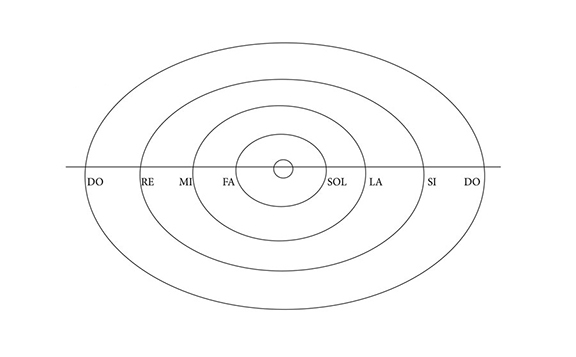
Although this is a gross over simplification of his idea,
the Greeks might have had this in mind when constructing
their music. Here a cross section of four planetary
orbits show the musical scale as an overtone series
paired with its reflection or undertone series.
Schlesinger's undertone series is the missing link
in a music theory relying on strictly overtones.
The main tonality of "Ode
to Greta" is the silent G#.
G# bisects D in half creating a
tritone with D.
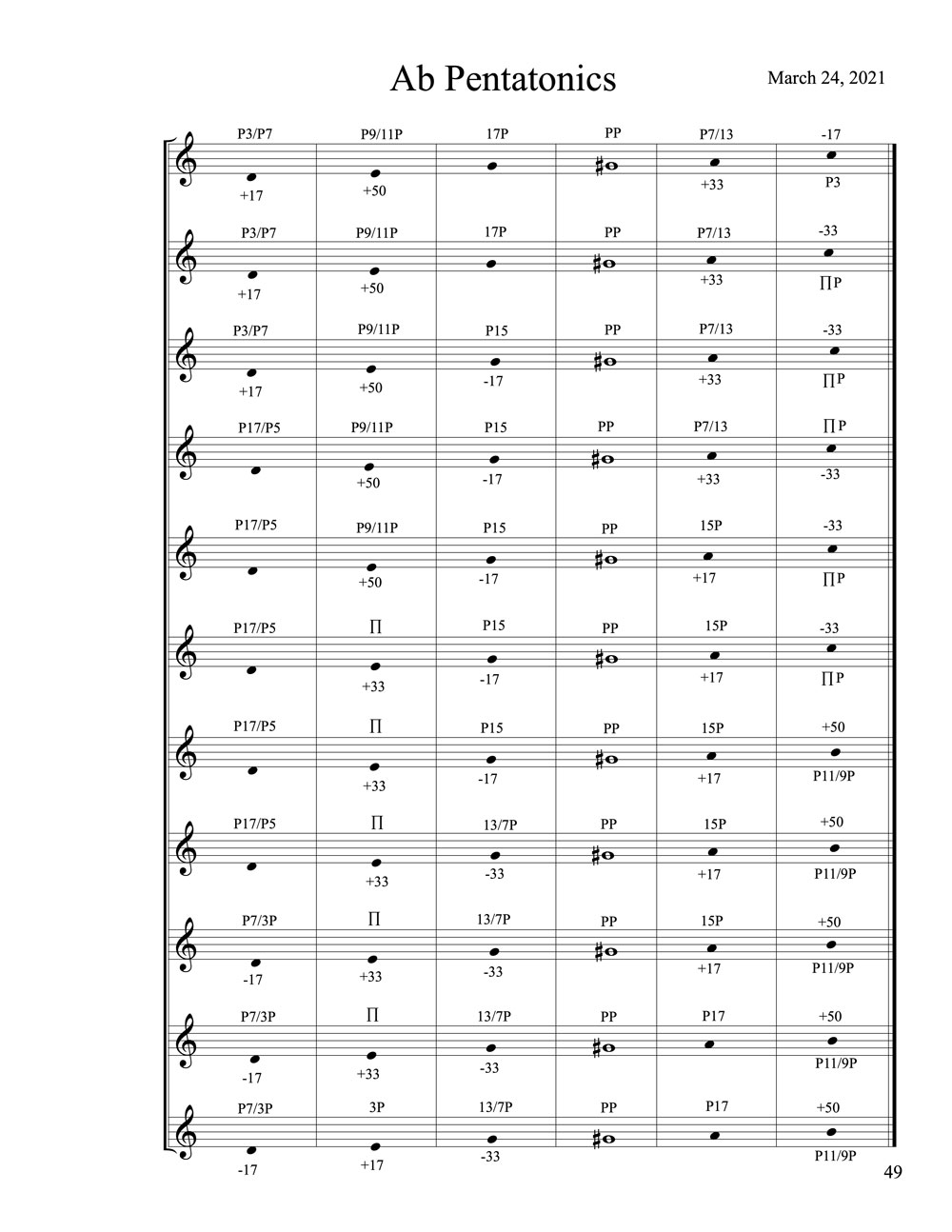
11 quasi-equal pentatonics are
generated
in the upper harmonics,
creating:
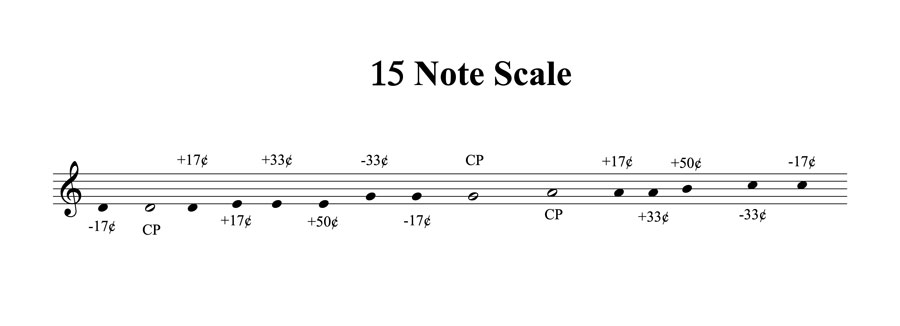
Notice the 2 tetrachords
outlined by the "concert pitch" (CP) notes,
and how the scale splits down
the middle at the silent tritone .
|